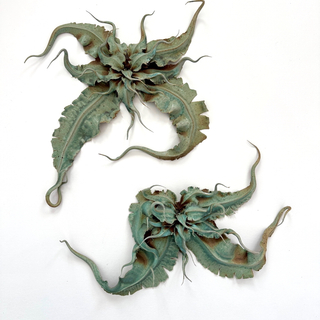
CHRISTOPHER ADAMS

Through repetition, geometry, biological forms, and rule-based processes, SYSTEMATIC explores how patterns emerge from organic, computational, and intuitive systems. Bringing together seven artists, the exhibition examines structures and processes informed by mathematics, science, technology, and the natural world. Featured artists include Christopher Adams, Sue Beyer, Amy Cheng, Paul Corio, Rob de Oude, Christine Romanell, and Sung Won Yun.
Drawing on his background in evolutionary biology, Christopher Adams creates ceramic sculptures that suggest newly discovered forms of life. His work explores adaptive radiation: how related organisms can develop strikingly different characteristics while retaining a shared underlying structure.
Working across painting, objects, and digital media, Sue Beyer explores how technology shapes contemporary experience. She brings data, personal histories, and physical materials into contact, testing the boundaries between what is human, digital, and machine-made.
Inspired by astrophysics and quantum physics, Amy Cheng creates richly layered compositions that move between microscopic and cosmic scales. Geometry, ornament, and repetition become a way to imagine relationships between living forms, consciousness, and the universe.
For Paul Corio, geometry provides a framework for exploring color. He arranges carefully mixed hues in repeating sequences, then follows the visual possibilities that emerge, allowing disciplined structure and intuitive decisions to shape each painting.
Rob de Oude builds his paintings through measured repetitions of line and color. Small changes in angle and layering generate shifting rhythms and optical effects, turning a precise process into an experience of movement and visual uncertainty.
Christine Romanell uses bold color, rotational symmetry and layered forms to investigate patterns that seem capable of expanding indefinitely. Informed by cosmology and sacred geometry, her work gives dimensional form to ideas about order, scale, and infinity.
Sung Won Yun draws on biology, ecology, and geology to explore growth and the passage of time. Through accumulated layers and recurring organic forms, she considers how countless individual events become part of a larger, interconnected whole.


